 Skip to main content



Check Valve Guide
Ready to Buy! In stock, off-the-shelf options
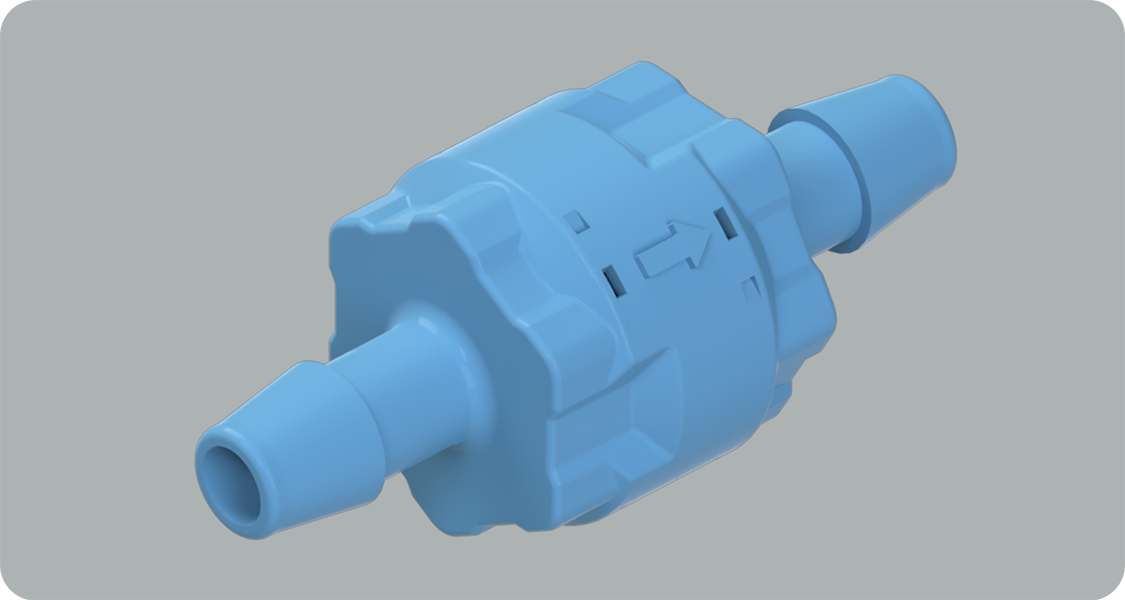
Poppet
Our Poppet Check Valves are available off the shelf or for more options you can build your own by using our check valve configurator. We offer barb and push-in as connection options and these are easy to take apart for R&D purposes, ensuring you find the perfect Check Valve for your project.
Key Features
- Connection: Barb, Female Thread and Push-In
- Sizes: 1/8", 1/4", 5/16", 3/8", 4mm & 6mm
- Seals: Nitrile (other options available)
- Material: Glass Filled Polypropylene (FDA CFR21 approved)
- Cracking Pressure: 3 psi (other options available)
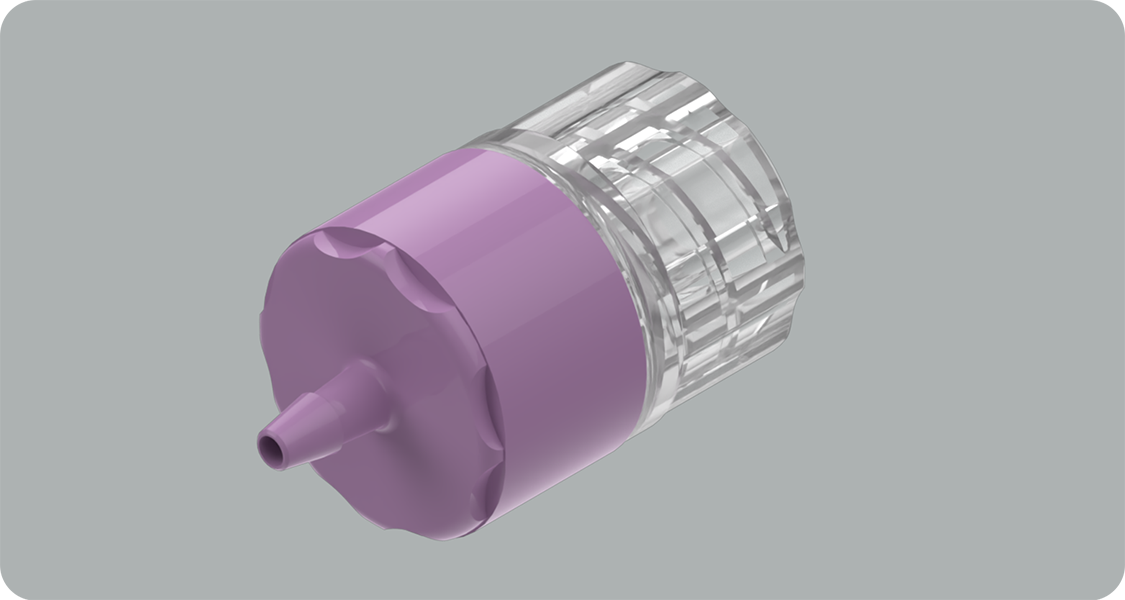
Diaphragm
These Miniature Luer Check Valves are manufactured in a Class 8 cleanroom and made to the ISO 80369-7 standard, these valves are well suited for use in single-use applications where the need for a high grade medical check valve is required, these are available in filtered or non-filtered options.
Key Features
- Connection: Barb to barb or barb to Female/Male Luer
- Sizes: 1/8", 1/16", 3/32"
- Cleanroom: Class 8
- Material: ABS with Silicone Disc
- Cracking Pressure: ≤1 psi
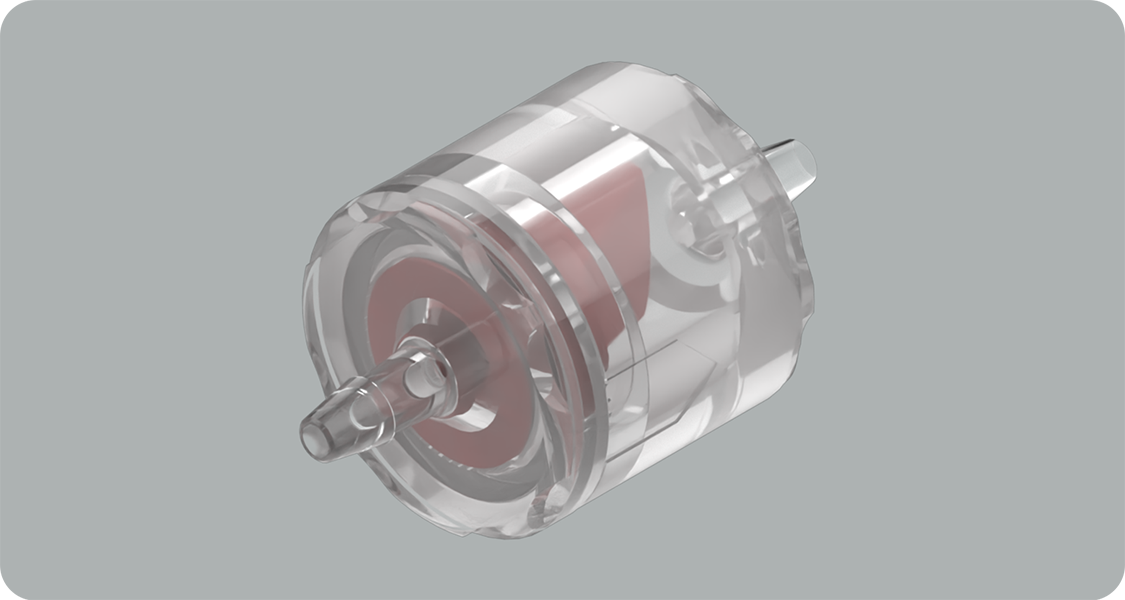
Duckbill
Our duckbill check valves are manufactured in a Class 8 cleanroom. Their distinctive shape allows the valve to open under forward flow and seal tightly against backflow, even at low pressures. These valves operate solely on line pressure and backpressure, requiring no external energy source.
Key Features
- Connection: Barb to barb
- Sizes: 1/16" (1.6mm) ID Tube
- Cleanroom: Class 8
- Seals: Fluorosilicone
- Material: ABS
- Cracking Pressure: ≤0.36 psi
Check Valves at a Glance
Check valves are an essential component in many pneumatic and fluidic systems, preventing the possibility of reverse flow (backflow), opening at a designated pressure and in some applications (e.g. medical, food & beverage) ensuring that cross-contamination does not occur upstream. Below is some useful information on considerations for selecting the right check valve for your project.
Need help finding the right check valve?
Why Choose our Check Valves?
The EoxMfg range of modular check valves is manufactured using “modular” tooling which enables us to make many variants of input and output connections in a cost effective way (typically hose barbs in varying sizes and luer thread connections). The most popular and often used variants are shown in our current range but if you require a different configuration or e.g. reverse flow then please contact us. They are also well suited for smaller trial and prototype applications right up to large scale production quantities.



Customise Your Check Valve
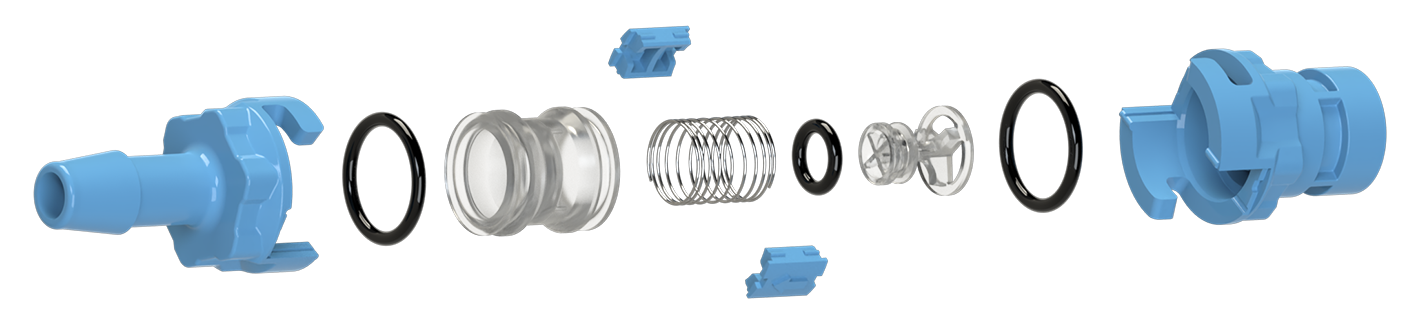
Our check valve configurator enables you to build the component your application requires - all of our parts are RoHs & REACH compliant.
Choose connection types, O-ring and material to create your optimum solution.
Things to consider when choosing a check valve
Check valves are an integral part of many medical devices but choosing the correct one can be difficult, with the many different options and check valve styles available.
EoxMfg can guide you through this process and help you select the perfect check valve suitable for your device. Click on the icons below to learn more.


Media Compatibility
Like any element in a system the media compatibility for the materials used in the construction of a check valve need to be respected. For EoxMfg components we list two criteria - the first is “wetted” materials. These are any materials in the valve that come into contact with the media passing through it and should be well resistant to it. The other is “non-wetted” materials. These are materials that are part of the valve itself but do not come into contact with the media passing through. They can be very important as they may come into contact with media or materials that are outside of the valve – a good example of this may be a cleaning procedure for the device that uses an alcohol agent to do so.

Temperature Tolerance
Like media compatibility, the temperature of the media (the working temperature) and the temperature of the environment (the ambient temperature) need to be respected with the materials the valve is constructed of. Because Eox defines the “wetted” materials – the materials that the media will come into contact with and the “non-wetted” materials (media does not come into contact with) you are able to select a valve that is suited for both temperature criteria.

Pressure Tolerance
When considering the pressure being used in a valve one has to consider both the operating pressure i.e. the pressure at which the valve should open or close and the max pressure that the valve could experience, in a system failure for example. This would be best described as the valve having a spring rating to suit the application and its total maximum pressure that the valve could withstand. When selecting the application pressure (i.e. the spring pressure of the valve) it is advised to select one slightly above the desired pressure to achieve better resolution and accuracy in the valve’s use.

Spring Tolerance
Most commercial springs have a tolerance at which they differ from the specified rating. EoxMfg state that the springs have a +/- 20% tolerance. This means that a spring rated at 1psi could open (or “crack” as it is commonly known) between 0.8 psi and 1.2 psi. You should build this factor into your system design. If it is important that they work at a much closer tolerance then they can be “sorted” this involves testing each valve with the spring fitted and eliminating any that are not with the desired rating, which would entail a time and cost consideration.


Orientation
Many valves work independently of gravity, such as those that operate with a spring and will work in any orientation. However, some valves that have a closing mechanism such as a “floating” disc or ball that require reverse pressure to close, may be adversely affected by gravity depending on where they are positioned.


Stiction
All materials experience friction and also stiction (the force required to overcome the initial resistance between two stationary surfaces).. Some materials are better at reducing stiction than others e.g. ceramic sealing surfaces. This is a known phenomenon in engineering and often it is not an issue in a system. However, there are instances where it can be adverse to the operation of the device – examples of this are when the valve requires to open very quickly as stiction can affect the opening time and also if the valve has been sitting idle for a long period and then is required to open. If the lack of stiction is important to you then EoxMfg recommend that you test the valve in a simulated application of your device to ascertain it’s suitability as it is very difficult to select it without doing so.
Custom Options & Extras
- Custom made components designed by our in-house team to meet your specific requirements including connection, material and performance options
- Multiple connection configurations engineered for compatibility with a wide range of tubing options
- Customisable logo, marking and identification options to support traceability, batch control and branding
- Ultrasonic cleaning to ensure components are thoroughly cleaned to a high standard suitable for healthcare and lab environments
- Passivated surface finishes to improve corrosion resistance, media compatibility and long‑term stability in sensitive environments
- Specialised bagging and packaging solutions including cleanroom and application specific handling requirements
- Off-the-shelf ready to buy O-rings